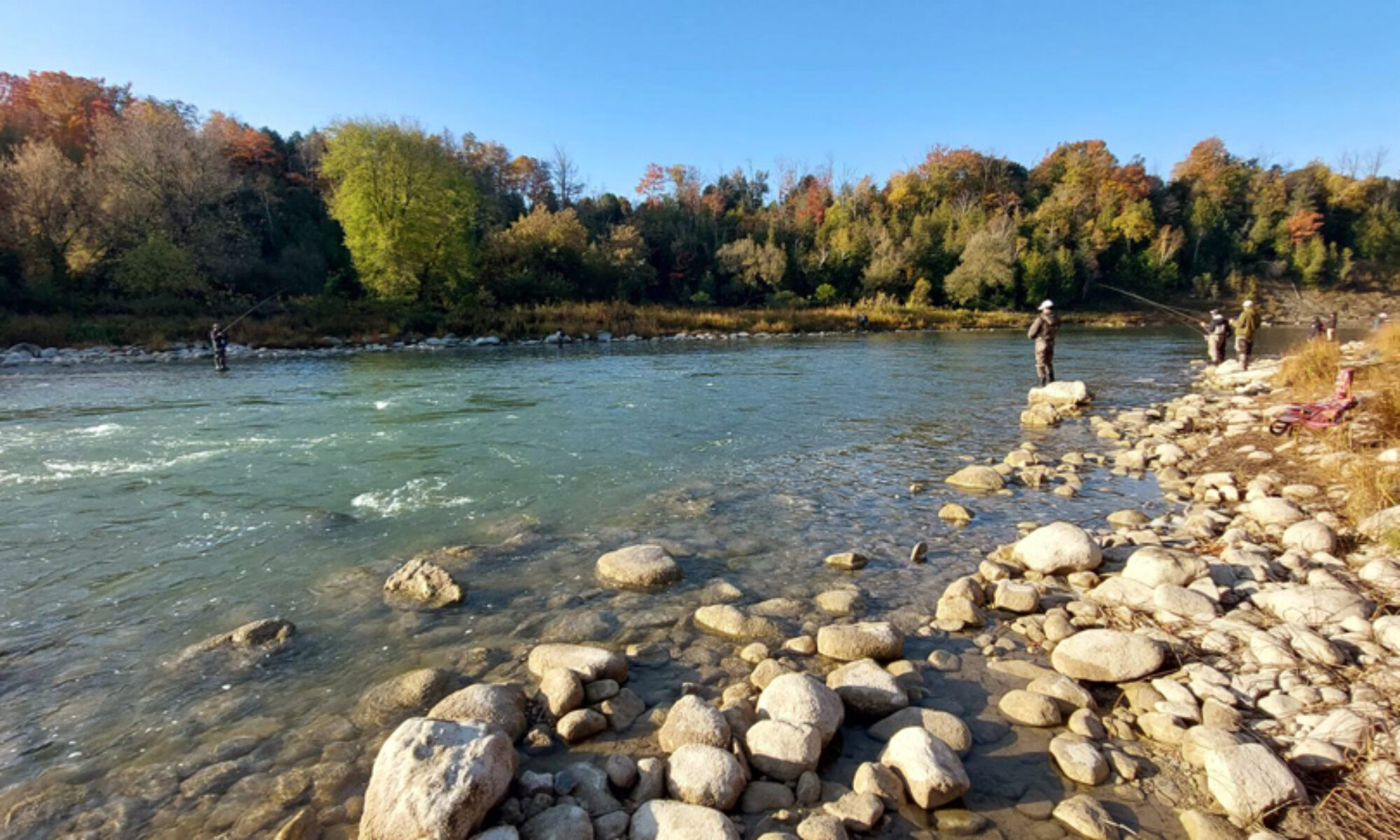
Well, here it is officially spring, and considering the weather we have received lately it is feeling like an early summer. Our membership roster continues to grow and presently we are well over 190 members strong and growing every day! Things have been relatively quiet over the winter but we are gearing up for the Spring/Opening season and expect to be quite busy over the ensuing months. We will be offering Membership renewals at the upcoming Spring Derby so please see me for your renewals. The Ontario Steelheaders success is directly related to the strength of its membership, so I urge you all to continue to support our efforts by renewing your membership. Let’s see if we can top 200 members this year!
I have received many comments from the membership applauding all the efforts from the volunteers. Some have even taken the time to write a letter and I would like to share with you all the comments received from one such member. He writes:
“I’m a fly fisher and this past year has been the first that I’ve gone outand really worked at trying to consistently catch steelhead. By all accounts, the Bighead and Saugeen have been great this year and I’ve been able to catch and release more steelhead than all my other years put together. This is undoubtedly due in large part to the efforts the Ontario Steelheaders have put forth…Congratulations, on what has obviously been a job well done”.
As always, you are more than welcome to contact any one of us on the Board of Directors with your questions, comments, suggestions, concerns and of course praise is always welcomed 🙂
Madeline Walker Membership Director Ontario Steelheaders membership@ontariosteelheaders.ca
The Ontario Steelheaders are interested in putting your talents to work! If you believe you have a special talent to contribute to the management of this organization, please don‟t delay!! There are many ways you can contribute as our directors require assistants to complement their efforts.
Please contact a director and we will do our best to put your skills to work to enhance and protect this fishery.
Published by Gary Sherman
Source: Fall 2011 Ontario Steelheaders Newsletter
Backgrounder: In 1996 The Saugeen Valley Conservation Authority announced that Denny’s Dam Conservation Area would be closed to the public due to financial constraints. The possibility existed that the property may even be sold.
The Ontario Steelheaders, consistent with its mandate, approached the Authority with an offer to lease the Park and co-manage it in order to ensure continuing access for all resource users. This resulted in a significant financial commitment to the Ontario Steelheaders. Monies generated by our activities at Denny’s Park, are from time to time earmarked for park improvements and fisheries enhancement projects. Our committee works diligently to collect funds, and to run the park efficiently, in order to make these ventures possible. The Ontario Steelheaders would like to thank everyone for their timely payments which make these and other improvements to our park and our fishery possible. Thank you! It’s your park! Use it, respect it, and support it!
Chairman’s address:
Well here it is fall already, seems like just yesterday we were busting up ice bergs just to get into the park. The spring ice jam certainly created havoc with the camp but through efforts of a lot of people it was brought back into shape.
Some of the camp improvements this year are the placing of speed limit signs, a new collection box which is more secure to collect funds and a new portable toilet at the west end of the park. We would like to thank everyone who helped in any manner in maintaining and improving the park.
There are two projects that need to be singled out:
Washroom Roof Improvements
First, is the placement of a concrete floor and eaves trough at the Rod Jones Pavilion; I know a number of people were involved in the labour portion of this project but special recognition is to be given to Derek Czarnota (Derek‟s Construction) for the donation of all materials required for this project.
The other is the new roof for the washrooms. Bob Pfaff spent a large portion of his holidays installing the new roof with donated materials that he required. These materials were given to us by Mr. Tom Ware of Hy-Grade Steel Roofing in Guelph. Once again thanks to everyone for efforts that make our park what it is.
Left: Ontario Steelheaders Volunteers replace the roof of the privy at Denny’s Park
On a different note I would like to remind everyone that the use of abusive, insulting or threatening language, making excessive noise or disturbing other persons is forbidden in Denny‟s Park and on all SVCA properties. The vast majority of our users enjoy the park for what it is, and respect the regulations. The minority, I ask you to rethink why you are here and join with us to ensure that our park will be here for everyone‟s enjoyment far into the future. Please be mindful of your neighbours.
I do not want to leave you with the idea that the news is all bad because it is far from that. We hosted three youth groups this year at no charge that enjoyed our facility and were very thankful for our hospitality.
Through park revenues generated, we donated $100 to the Goderich Relief Fund, $2,000 to the Lake Huron Fishing Club for the rearing of smolts and transferred $4000 to the Ontario Steelheaders Fisheries Enhancement Team to help with their work.
The Saugeen Conservation Authority and its board members toured the park and were very impressed with the park and the work the Ontario Steelheaders do as a whole.
It has been a learning year for your committee and I would like to thank each of them for their efforts. I know there were times you felt like walking away but stayed. Through your hard work, take pride in the accomplishments of this year.
Project Chair, Gary Sherman
Approximately six months ago I asked for a meeting with the District Manager of the Ministry of Natural Resources Shawn Carey and also Dave Reid the Upper Great Lakes Manager for the Ministry of Natural Resources. The reason for the meeting is discussed under the next title in this newsletter, but before we get to that subject, let me first say that the Ontario Steelheaders have entered into an agreement with the Ministry of Natural Resources to give the Saugeen River steelhead enhancement program a „little‟ additional injection of rainbow trout for the coming year.
To complete one objective, it was suggested that the Ontario Steelheaders also take „advantage‟ of the opportunity to rear additional rainbow trout to the fry or fingerling size. Now again, for the last time, I don‟t like raising fish to waste fish. I don‟t believe in stocking fry or fingerlings of any species or for that matter stocking them in the wrong locations, but I believe we came to a mutual and satisfactory compromise in this „one time‟ only stocking project.
After the meeting I contacted our president Karl Redin and got the go ahead to move further with this proposal. From there I met with Al Wilkins the Lake Huron Fishing Club president. The following program is now well underway and will be completed by the second week of November.
Here we go with a brief explanation. Yes, we took up the opportunity to expand our program for this year only. We have entered in to a one time only project of raising and releasing an additional 65,000 „advanced‟ fall fingerling rainbow (steelhead) during the first weeks of November, with all fish being released into a 50 mile stretch of the Beatty Saugeen between Hanover and Highway 6.
Thanks are extended at this time to Al Wilkins president of the Lake Huron Fishing Club, Gary Biederman the hatchery manager of the club‟s Port Elgin fish hatchery, Grant McAlpine and his crew of tireless workers at Denny‟s Dam.
This one year only program will not only enhance the river and lake fishery, but will also significantly increase the number of spawning adults in the future to our target site…the Beatty Saugeen.
These fish are being released into some of the finest trout-suitable waters in the province. Water temperatures are fairly constant with little over-winter freezing and related winter mortality. These fish will grow, smolt, imprint, and know how to get home when they mature and return from their stay and maturing in Lake Huron. Ten locations have already been picked on the Beatty for fingerling release, which will maximize survival of the young fish.
Now for the icing on the cake… and I couldn‟t really disclose the following until I sat down at the computer a few hours ago and to be honest, I never really thought it had much of chance of happening.
Now remember, it‟s been a long time since the Ontario Ministry of Natural Resources has carried out any stocking of their own of rainbow trout on the Saugeen River and I don‟t believe their program consisted of any actual upstream „imprinting.‟
At the meeting I suggested that it would nice if the MNR complimented the volunteers‟ efforts for their work over the past five years. The question was asked, just what was I suggesting?
The answer was simple. I suggested the Ministry of Natural Resources also match a similar number of rainbow trout for the Saugeen River that would be reared from Saugeen River eggs at a ministry hatchery and also imprinted in a similar manner already being carried out by the volunteers.
Well, this morning I received confirmation from the Ontario Ministry of Natural Resources that starting in the spring of 2012 we will supply the Ministry of Natural Resources with 100,000 eggs that were in the past allocated to our now closed down Mildmay hatchery. These eggs will be isolated, incubated and raised at the government‟s Chatsworth hatchery facility. These additional yearlings will be ready for spring release in 2013 to compliment the program presently being carried out by the volunteers of Ontario Steelheaders and Lake Huron Fishing Club. The MNR complimentary program is to be run in conjunction with the volunteers‟ project for a term of 3 to 5 years. It definitely will add an additional boost to our goal of transforming the Saugeen into the finest trout stream east of the Rocky Mountains.
Let’s keep working together as clubs and individual sportsmen. It can only get better.
The Saugeen is one big, big river. It offers more than 100 miles of excellent trout fishing water and over 70 miles of prime spawning and nursery habitat.
The steelhead is a target species for not only the river fisherman, but as a much sought after Great Lakes species. Our strides have proven themselves and are being recognized throughout the province.
Well, it’s getting to be that time of year when seasons swing us to cooler temperatures. I trust, we all for some time at least, got to enjoy the warmer, sunny days of summer. For those of you whose acquaintance I have not made, my name is Harold Curtis. I am Secretary/Treasurer for the Ontario Steelheaders.
We would like to take this opportunity to let our membership know how our collective funds are being used.
Dec. 12, 2010 – $ 2000 for work on the Traux Dam Fishway in Walkerton
April 24, 2011 – $ 2000 for L.H.F.C. to help with the cost of rearing 2011-12 yearlings.
July 4, 2011 – $3000 to L.H.F.C. to help with the cost of rearing enhanced fall-release smolt.
Sept. 6, 2011 – $5000 towards new Maple Hill Dam Fishway.
In less than one year, we‟ve injected $12,000 into fisheries enhancement projects. We also have had numerous smaller expenses we have incurred in the day to day operations of the Ontario Steelheaders.
I would also like to share with all of you folks a list of friends of the Ontario Steelheaders who have made donations to assist in our efforts:
Canadian National Sportsmen’s Shows Ltd.
Sauble Men’s Club
United Brotherhood of Carpenters and Joiners of America. Local Union 785
John Topp
Strutin’ Tom’s Turkey Club of Walkerton
John Campbell
Hammond Power Solutions Inc.
Sobey’s Milton
I personally, as well as the rest of our members would like to express our gratitude for the generosity shown to us by these groups and individuals. A special note of thanks, to the families and friends of Dave Bartholomew and Bertha Mills for the donations made to us in their memory.
I will continue to visit the post office and bank, and keep our books up to date. See you all out there sometime!
Regards,
Harold Curtis
Secretary/Treasurer Ontario Steelheaders
It‟s great to inform everyone that approximately 65,000 steelhead yearling smolt were released once again this past spring into the mid-stretches of the Saugeen River below the Walkerton Dam and also into Otter Creek. These prime conditioned 12 month old fish were given a lot of tender loving care by the members of the Lake Huron Fishing Club who raised them from the egg stage to up over 8 inches in length.
Again, the reason for releasing these fish more than 50 miles upstream is to imprint the fish for great returns to prime spawning water. It‟s imperative that these fish get a good dose of the Saugeen so that when they do leave the river they know just where and how to get home again and into prime spawning waters.
I have a little saying that we should never raise fish to waste fish. Size at stocking is all important and the Lake Huron boys definitely get them up to the proper size. The next important thing is where to stock them for maximum imprinting and that‟s into waters below and above Walkerton
A Retrospective look at the Saugeen River by Rob Heal
On a cold, hard Sunday in late March of 1994, with an unrelenting wind blowing hard out of the west and driving the frozen rain against my face, I caught my first fly rod steelhead. She was one of three that I hooked and landed among the boulders above the big rapids on the Saugeen River at Southhampton. It‟s a beat that just looked fishy and although none of those steelhead were large, the big, brawling spring flows made each fight epic. It was that day, just after landing my third fish and feeling satisfied while sipping on a cold can of beer in the midst of a late winter storm that I knew I was truly screwed. It‟s what a horse racing enthusiast feels just after his first horse finishes in the money. “That was as exciting as a hell but it‟s going to cost me.”
A year later, on opening day of the general trout season the weather was different. Big, fluffy clouds drifted by a high, blue sky and only occasionally eclipsed the sun. The water was clearer than normal for this time of year as the run off had settled and spring was a full two weeks early. I was floating the Saugeen this time in a Mackenzie River drift boat through a sector in Walkerton and as my guide John Valk had indicated, we were seeing fish. Lots of fish! To be clear, we were seeing lots of redding fish; hundreds of them oriented to the gravel on the shoulders of the main flow and seemingly very content in what they were doing. These were the late run fish that were just finishing or very close to finishing their job as parents and getting back to the business of being trout. This redding activity started in town and continued for the 10 km that we drifted. Just about every inside bend or current break that maintained gravel and a uniform flow held redding fish and to this day, it is one of the most remarkable sites that I have every witnessed. 16 opening weekends later, it still impressed the hell out me.
Over my 15 years as a professional guide, I would reckon conservatively that I have drifted that beat or a similar one about 600 times and I‟ve floated, fished and made observations on every inch of the river from Maple Hill dam to Southhampton save for 400 m downstream of the Truax Dam in Walkerton and the same distance below Denny‟s Dam to the trailer park. (Of course I‟ve fished both sections but not from a drift boat.) I‟ve seen it at its best when all of the requirements for great steelhead fishing are in place and I‟ve seen it when nothing seems to go right. I‟ve often lamented that no one complains about the weather more than farmers and fishermen, and feast or famine is the norm. Occasionally though, everything lines up and no matter how hard one tries, it‟s difficult not to catch fish. Spring of 2006 was one of those years. The sun rose on opening day to nearly perfect flows and just enough rain fell for the critical weeks of spawning that the fish and their eggs thrived. Returning kelts left their redds to favorable water temperatures and the eggs that they left behind had near perfect conditions to mature and hatch at a high percentage. The fishing for kelts that year was off the charts with just about every run holding groups of hungry, post spawn fish just waiting for a bunny leach or wooly bugger to drift near them. I‟m not a numbers guy but when the fishing is that good it causes you to take a second look or in my case, a second guess and during that season I often found myself sitting at the rowers bench recounting the events of the day and debating with myself, “My god, was that the 14th or 15th fish hooked?” I had two days with more than 20 hooked fish that year and on one occasion, I had to call my shuttle service and get him to re-shuttle my truck. You see, we had put in at the Tim Horton stairs in Walkerton but hadn‟t reached Lobby‟s park at 3:00pm. We had hooked a full two dozen fish at that point and I began playing a bit of game with myself trying to find a fly that hungry kelts wouldn‟t hit. I didn‟t find one. As I said, I‟m not really a numbers guy but that‟s three fish an hour, not including bumps, hits or brief encounters. That was fish hooked, fought, landed or lost and I don‟t care who you are, that‟s pretty good angling. My spring tally to the 28th of May was 107 fish landed so my guess is you could conservatively triple those figures with fish burned. I also landed seventeen myself that year, so that brings the number to 134. I guided or fished 33 days from April 17 to May 28 so if you do the math, that‟s just over 4 fish a day landed! But I‟m not a numbers guy.
Thank the Fish Gods for balance as the following year was a 180 degree difference. 2007 had pretty good fishing in late March and early April but come the opener, it was all but over. May the 8th was the last day that I guided for steelhead and I admit now that I was pushing it. I followed the fish from Walkerton to Southhampton, fishing all beats in between until there was simply no steelhead remaining in the river. Water levels dropped to disastrous levels threatening to de-water redds and exposing eggs to the air and sun. Recruitment for 2007 we guessed would be have been low and we all lamented that 2011 or „12 would yield low returns as a result. Mother Nature gives and takes away.
That’s where the Ontario Steelheaders come in.
Even Mother Nature needs a “helping hand” occasionally as, despite her best efforts, things don‟t always go as planned. In the Saugeen‟s case, and during the fruitful years when conditions are good, recruitment can be high. Conversely, one bad year like that of 2007 can set things back considerably. As we know, the juvenile steelhead spends between one and three years in the river before descending to the lake. Here, they grow to maturity and feed on what the fertile lake has to offer before returning to the river one or two years later to spawn. Looking at the math of it, after the low water conditions of 2007, I anticipated doom and gloom for 2010 and „11. But it didn‟t happen. In fact 2009, „10 and „11 would have to be considered bunker years in terms of returning fish and the subsequent recruitment. Why did this happen in the face of such desperate odds? Mother Nature did get her “helping hand” in the form of the quiet help of the Ontario Steelheaders. Through the tireless efforts of the men and women pushing for funding, the volunteers that collect the eggs, transport mature fish up stream and monitor the progress of the fish being reared at the hatchery, the fishery thrived.
For the past five years when the conditions were conducive, I‟ve made it a point to drift sections of the river prior to the season opener. What I‟ve observed is astonishing. For the past three years, the number of spawning fish upstream from Denny‟s dam was extraordinary. In one 14 km stretch, while scouting during the third week of April 2009, I estimated 300 spawning fish. That is the number of redding fish that I could actually see and I know that I missed many. Over the span of suitable spawning area, I would guess that there were over 1000 redding fish during that period alone. I would also guess that that number represents only 10 to15% of the fish that had completed spawning or had yet to commence. My conclusion, having observed the river through the years when the accepted number of returning fish was between 5000 and 7000 annually and getting a close look at the spawning activity over that same period, the current number of returning fish has to be between 50 and 75% higher than that of the mid ninety‟s. Not bad for a bunch of unpaid volunteers. All of these figures have little scientific backing but are based on thousands of hours of observation, the journal that I‟ve kept for the past 16 years, and keeping up with the what the Ontario Steelheaders have done over that time.
2011 saw what I consider to be the highest number of spawning fish to date in those same area‟s upstream of Denny‟s Dam but there‟s more to consider than just that. Add to that the fact that much of the spring was unfishable, allowing the fish to get busy without interruption throughout most of the spawning season and then return to lake under near perfect conditions and I‟ll go out on a limb and say that the years following and specifically 2014 and 2015 will yield record numbers. I for one am anxious see the day that the hard work of the Ontario Steelheaders comes to fruition. What is fruition though? To many it means the day that the Saugeen has a viable, self-sustaining steelhead fishery that requires less work to maintain and provides a meaningful contribution to the economy of the small towns that line the river. That day may be a long ways off or closer than we think but I have the feeling, regardless of the rivers current condition, that the Ontario Steelheaders won‟t rest and will continue to be the driving force behind a river with the highest potential. Are we there yet? I‟ll bet if you ask anyone involved, they‟ll say that we still have a long ways to go but the future is defiantly bright indeed.